• Skip to main content
  • Skip to primary sidebar

Ask Liz Weston

Get smart with your money

  • About
  • Liz’s Books
  • Speaking
  • Disclosure
  • Contact

Student Loans

My book is out! Get it for free.

March 7, 2013 By Liz Weston

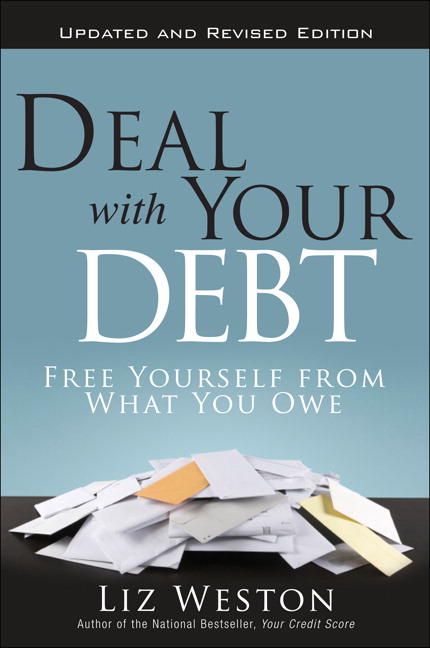
DWYD cover2013“Deal with Your Debt” is now available, and I’m giving away five copies this week.

To enter to win, leave a comment here on my blog (not my Facebook page).

Click on the tab above the post that says “comments.” Make sure to include your email address, which won’t show up with your comment, but I’ll be able to see it.

If you haven’t commented before, it may take a little while for your comment to show up since comments are moderated.

The winners will be chosen at random Friday night. Over the weekend, please check your email (including your spam filter). If I don’t hear from a winner by noon Pacific time on Monday, his or her prize will be forfeited and I’ll pick another winner.

Also, check back here often for other giveaways.

The deadline to enter is midnight Pacific time on Friday. So–comment away!

Filed Under: Liz's Blog Tagged With: Bankruptcy, book giveaway, books, Budgeting, collection agencies, collections, Credit Bureaus, Credit Cards, Credit Reports, Credit Scores, credit scoring, Deal with Your Debt, debt, debt collection, debt settlement, Debts, mortgages, Retirement, retirement savings, Student Loans

Graduating without student loans is tough

February 15, 2013 By Liz Weston

Education savingsA few months ago I gave a verbal spanking to a woman who equated college loans with handouts. She wondered why people didn’t just delay college for a year and earn enough money to pay for their entire education, as she did back in the day.

I pointed out that there weren’t many jobs available to newly-minted high school graduates that paid $60,000, which is about the minimum you’d need to pay for a four-year degree today.

Apparently my reader isn’t the only one having trouble keeping up with the times. A recent New York Times story quoted Virginia Foxx, a Congresswoman from North Carolina who heads a House subcommittee on higher education and work force training, saying she was bewildered why people went into debt instead of working their way through school the way she did.

Here’s what Times writer Ron Lieber pointed out:

But students nowadays who try to work their way through college without parental support or loans face a financial challenge of a different order than the one that Ms. Foxx, 69, confronted as a University of North Carolina undergraduate more than 40 years ago. Today, a bachelor’s degree from Appalachian State, the largest university in her district, can easily cost $80,000 for a state resident, including tuition, room, board and other costs. Back in her day, the total was about $550 a year. Even with inflation, that would translate to just over $4,000 for each year it takes to earn a degree.

A plucky, lucky few manage to get through college with no loans or parental support. But many of those who try wind up dropping out, unable to balance the work hours required with the demands of school.

If you’re one of those who may be stuck trying to pay your own way, Zac Bissonnette’s book “Debt Free U” can provide helpful guidance. If you’re a parent or a policymaker, however, you should check your views about the viability of kids’ working their way through college with today’s realities.

Filed Under: College Savings, Liz's Blog, Student Loans Tagged With: college, college costs, college debt, college students, college tuition, Student Loan, student loan debt, Student Loans

Settling co-signed student loan debt

January 21, 2013 By Liz Weston

Dear Liz: My daughter co-signed a student loan for a friend who failed to pay the debt. Now my daughter cannot refinance her home because this loan appears on her otherwise very good credit reports. She has been getting calls from a collection agency.

I called the agency to discuss what it would cost to get her released from all liability regarding this loan, and they gave me an offer of $13,000 to satisfy the debt, which is now $35,000. I countered with $9,000, since the original loan was just $15,000, but they refused. My daughter is unhappy about paying anything, since her ex-friend is a gainfully employed attorney. Is it good business to pay what the collection agency is asking, or should I continue to negotiate?

Answer: That sounds like a pretty good offer, said financial aid expert Mark Kantrowitz, publisher of the FinAid and Fastweb websites.

“Lenders almost never settle for less than the outstanding principal balance of a defaulted student loan, so that may be the best she can get,” Kantrowitz said. “It may be the case that they are offering her a low settlement amount to release her from her obligation and then will go after her former friend for the remaining debt. When there are two borrowers on the hook, one borrower reaching a settlement does not cancel the debt. It merely releases that borrower from her obligation.”

Your daughter should have the settlement offer reviewed by an attorney, Kantrowitz said. The attorney should verify that the collection agency has the authority to settle the debt, and any agreement should list all of the loans involved.

“I’ve seen cases where a borrower thought she was getting a settlement of all the loans,” Kantrowitz said, “but the settlement was just for some of the loans.”

Ideally, the settlement agreement would require the lender to stop reporting the default and delinquencies to the credit bureaus, which would remove the stain from her credit reports. Not all lenders will agree to such a condition, Kantrowitz said, but removal would be better for her credit than simply having the debt reported as “satisfied.”

Also, the agreement should require that the lender provide a “paid in full” statement to your daughter as proof her debt has been settled, Kantrowitz said.

“She should keep this statement forever,” Kantrowitz said, “as defaulted loans have a tendency to resurrect themselves from time to time, [such as when] a bank reloads their database from old backup tapes [or] someone reviewing old records discovers the original promissory note.”

An attorney also could advise your daughter about taking further steps, such as suing the former friend for repayment or reporting the issue to the state bar, which has standards of professional conduct that may be violated by an unpaid debt.

Filed Under: College, Credit & Debt, Q&A, Student Loans Tagged With: college students, debt settlement, private student loans, Student Loan, student loan debt, Student Loans

“Compassionate review” may lead to student loan discharge

December 24, 2012 By Liz Weston

Dear Liz: We have a family member who recently was approved by Social Security for a complete disability claim. This person will never work again but has an outstanding student loan. The lender has a formal mechanism to apply for loan forgiveness, but is refusing to accept medical documentation of the disability. What appeal process is there and how can we force them to act? Do we need to retain legal counsel and incur additional expense to enforce a legal process and achieve loan forgiveness?

Answer: Federal student loans offer a “total and permanent disability discharge” that forgives outstanding education debt. You can find the rules and an application at DisabilityDischarge.com.

The rules for private student loans, however, vary by lender. Four lenders — Sallie Mae, New York Higher Education Services Corp., Discover and Wells Fargo — offer a discharge for total and permanent disability that is similar to the federal one, said Mark Kantrowitz, publisher of the FinAid.org and FastWeb.com financial aid sites. The Sallie Mae discharge is also provided on loans made through lenders that market the Sallie Mae loans, such as Commerce Bank, Fifth Third Bank and Regions Bank, Kantrowitz said.

Other lenders do not offer such a discharge, but all have a compassionate review process for their private student loans, he said.

“Borrowers in a difficult financial situation, or their family or other representatives, should contact the lender that holds the loan directly,” Kantrowitz said. “The call center staff are not always familiar with the compassionate review process.”

Lenders are generally more likely to cancel some or all of the debt, or at least reduce the interest rate, in a situation that permanently affects the borrower’s ability to repay, Kantrowitz said. They are less likely to make an adjustment when the loan was cosigned and the cosigner is capable of repaying the debt.

“But it varies,” Kantrowitz said. “I’ve seen some cases in which the borrower was military and killed in action where the lender forgave the loans even though the cosigners were capable of repaying the debt. Another example involved a mother whose daughter dropped dead on an athletic field and the mother’s anguish was palpable in the letter to the lender.”

Debt cancellation comes with another issue: taxes. Forgiven debt is typically treated as taxable income by the IRS. Your family member may be able to avoid the taxes if he or she is insolvent, but a tax professional should be consulted.

Filed Under: College, College Savings, Credit & Debt, Q&A Tagged With: disability, federal student loans, private student loans, Student Loan, student loan debt, Student Loans

Government recoups defaulted student loan debt

November 26, 2012 By Liz Weston

Dear Liz: I read your response to the person questioning the rationale behind taxpayer-supported federal student loans. Your response was well written, but do you have any information about how much money is owed to the government for student loans and what percentage of all the loans are actually paid back in full? You mentioned that the government can garnish wages and Social Security checks and seize tax refunds, but does the government follow through and hold these people accountable? Does the government have personnel to do this or is this just a threat?

Answer: Millions of unhappy student loan borrowers can assure you the government’s considerable powers to collect defaulted student loans are much more than a threat. In addition to its own collection activities, the U.S. Department of Education also hires a number of private collection agencies to help recoup what’s owed.

As a result, the government collects more than 100 cents on every defaulted dollar once accumulated interest and penalties are included, according to the Education Department’s most recent report. On a net present value basis — when future collections are discounted back to today’s dollars — the government recovers about 80% of the defaulted debt.

Decades ago, it was possible to skip out on federal student loan debt without serious consequences. Public outrage over that fact led to much stronger collection efforts. That has resulted in the federal government recovering about $10 billion in defaulted student loan debt every year, said Mark Kantrowitz, publisher of the FinAid.org and FastWeb financial aid sites.

Filed Under: College, College Savings, Credit & Debt, Q&A, Student Loans Tagged With: collection agencies, collections, debt collection, federal student loans, Student Loan, student loan debt, Student Loans

Student loans aren’t handouts

November 14, 2012 By Liz Weston

Dear Liz: I am increasingly annoyed by the entitlement attitude of today’s students. Why should the taxpayers (me) pay to educate somebody else’s children? I remember when there was no such thing as a student loan. If I wanted to go to college and didn’t have the money for tuition, I delayed starting college until I had worked for a year and saved up the money. Many of my friends did this, as did I. Now these kids stand around with their hands out looking for somebody to bring them their education on a silver platter. I wish you would say something about this in your column.

Answer: Let’s start with the obvious, which is that an education costs a heck of a lot more than it did when you were in college.

The College Board reports that a student attending an in-state, four-year public university needs to budget an average of $22,261 to pay for the 2012-13 year. Which means the total cost to get an undergraduate degree would be about $90,000, assuming he or she can get all the required courses in four years (something that’s increasingly difficult because of state budget cuts in education).

Not to put too fine a point on it, but there aren’t many jobs these days that would enable someone (particularly someone without a college degree) to save the full cost of a college education in a single year. Even someone who started out with two years of community college would need to budget about $8,000 for each of those years, according to the College Board, and the total cost of a four-year degree would still be around $60,000. Some people would pay less if they got a lot of financial aid or lived at home, but any way you cut it, the tab is much, much higher than it has been in decades past.

Something else has changed since you were a student, and that’s the importance of having a college education if you want to have a decent financial life and remain in the middle class. In your day, people without college educations — even those without high school diplomas — could find well-paying jobs. Those jobs have increasingly been phased out by technology or they’ve gone overseas. The manufacturing and technical jobs that remain often require at least some post-secondary education. Having a college degree is what having a high school diploma used to be — an essential entry-level credential in many fields.

Our nation and our economy need educated workers if we’re to be competitive in a global economy. It also would help to have an expanding pool of well-paid workers to pay taxes toward things like roads, defense, police and fire protection and Social Security, from which you presumably benefit.

This is why governments promote post-secondary education with a relatively small amount of grants for the needy, and a relatively large amount of loans for everyone else. The first federal student loans were part of the National Defense Education Act of 1958; today, most students borrow at least some portion of their education costs.

You see, most kids (and their parents) aren’t standing around waiting for a handout. Most financial aid these days comes in the form of loans, which have to be paid back. These loans aren’t necessarily cheap — the rate on a Stafford student loan is 6.8%, while graduate and parent PLUS loans have 7.9% rates (plus a 4% origination fee that’s deducted from each disbursement).

If students or their parents default, the government can garnish their wages, seize their tax refunds, take a chunk of their Social Security checks and trash their credit. There is no statute of limitations on federal student loans and only rare relief in Bankruptcy Court, so borrowers can be pursued to their graves for what they owe.

Yes, many families overspend on education and overdose on student loans. The majority, however, graduate with a reasonable amount of debt (about $26,000 on average) that can be repaid from their now-higher earnings. Student loans aren’t a handout — they’re an investment in both the graduate and our economy.

Filed Under: College, College Savings, Q&A Tagged With: college, college costs, college students, college tuition, federal student loans, Student Loan, student loan debt, Student Loans

  • « Go to Previous Page
  • Page 1
  • Interim pages omitted …
  • Page 58
  • Page 59
  • Page 60
  • Page 61
  • Page 62
  • Go to Next Page »

Primary Sidebar

Search

Copyright © 2026 · Ask Liz Weston 2.0 On Genesis Framework · WordPress · Log in