
• Skip to main content
  • Skip to primary sidebar

Ask Liz Weston

Get smart with your money

  • About
  • Liz’s Books
  • Speaking
  • Disclosure
  • Contact

financial aid

Does your kid need expensive SAT prep?

April 21, 2014 By Liz Weston

iStock_000014485809SmallBack when dinosaurs roamed the earth, I bought a fat paperback test prep book to help me study for the SAT (which, back then, was still known as the Scholarship Aptitude Test). I didn’t buy the book until after I’d already taking the SAT the first time. After studying, I took the test again–and did worse.

Not that I suffered for this experiment. I scored high enough to become a National Merit Scholar, which meant big bucks for college.

I recently asked a friend my age who was also a National Merit Scholar how he prepared for the test. He vaguely remembered being taught a few test-taking strategies in school. But that’s it.

The world’s changed in the past few decades. College is a lot more expensive and elite schools are a lot more competitive. High scores give kids an edge not just for admission but for all-important merit scholarships. Which is why SAT test prep is pretty much a given among upper-income parents. Even less affluent parents are spending hundreds or even thousands of dollars trying to boost their kids’ scores, as I write in my Reuters column this week, “Resist the urge to go overboard with test prep.” Not investing in test prep feels like a gamble that could leave your kid trampled in the dust.

These parents aren’t foolish or deluded. Scores matter, and most teenagers could use some help. My column mentions some free resources, and I highly recommend reading Debbie Stier’s book, “The Perfect Score Project: Uncovering the Secrets of the SAT.” Even if you can’t afford private tutors, you can do a lot to help your get your child ready for the test.

Filed Under: Liz's Blog Tagged With: college, college costs, financial aid, SAT, SAT prep, scholarships, test prep

Friday’s need-to-know money news

April 11, 2014 By Liz Weston

Zemanta Related Posts ThumbnailToday’s top story: What parents and students need to know about financial aid. Also in the news: Using your smartphone or tablet to clean up your finances, tax tips for procrastinators, and what to do when your teenager has become a financial disaster.

Eight Financial Aid Secrets That Parents And Students Need To Know
What you need to know before filling out the FAFSA.

12 Powerful Ways Data Can Help Clean Up Your Finances
Putting your smartphones and tablets to work.

6 tax tips for procrastinators
Tick-tock.

Help! My Teen is a Money Monster
What to do when your kid is out of financial control.

How to Budget For Health Care Expenses in Retirement
Health care expenses will eat up a significant part of your retirement savings.

Filed Under: Liz's Blog Tagged With: apps, financial aid, health care expenses, Retirement, Taxes, teens and money

Beware college financial aid letters

April 8, 2014 By Liz Weston

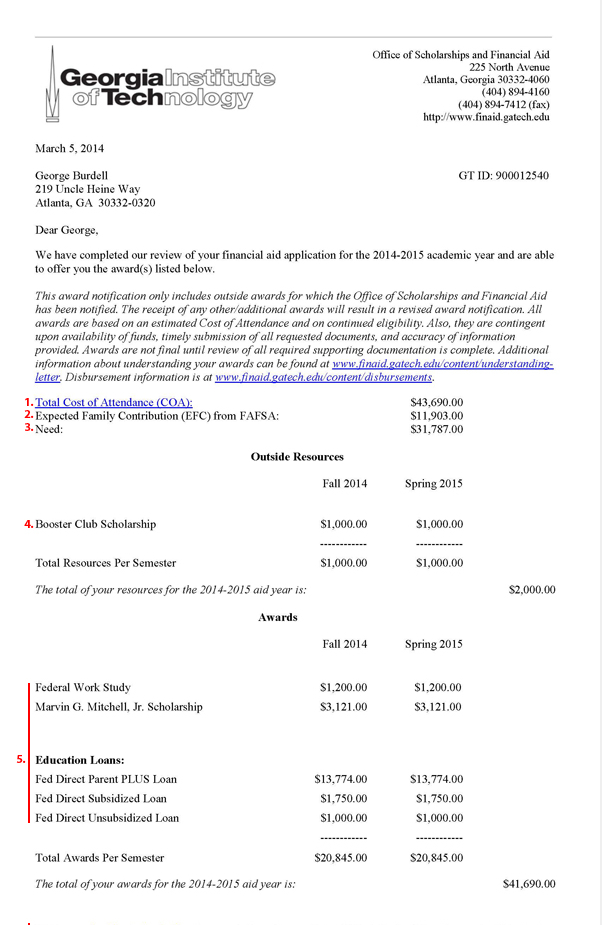
If you want to see what’s wrong with many financial aid letters today, check out the one that Georgia Institute of Technology has so helpfully posted on its Web site under the rather ironic headline “Understanding the Letter.”

Screenshot 2014-04-08 09.24.21The school does a few things right. Not all colleges include the total cost of attendance on their financial aid letters, and many don’t include the “expected family contribution”–what the family is expected to pay according to the Free Application for Federal Student Aid or FAFSA. Subtracting the expected family contribution from the total cost results in the family’s need. In this case, the need is $31,787.

The total award figure of $41,690 seems dazzlingly generous compared to the family’s need. It’s not.

Like many schools, GIT lumps together gift aid (scholarships and grants) with loans and work study.

In this case, the gift aid is just $8,242, which includes a $2,000 scholarship the student won on his own.

The vast majority of the “aid”–$27,548–are parent PLUS loans. PLUS loans are designed to help the family pay its expected contribution, which in this case is $11,903. PLUS loans don’t reduce the family’s $31,787 need.

This award that seems so generous actually meets a quarter of the family’s actual need with gift aid. When work study and the student’s loans are included, the percentage of need met is only about half.

Too many financial aid letters are even more obscure, as I write in this week’s Reuters column, “Don’t get fooled by financial aid letters.” Some don’t include any cost information, while others list partial information. Some don’t spell out what’s a loan and what’s not. Fewer than half of schools use the federal “Shopping Sheet,” which was designed to help stop misleading financial aid letters and allow families to compare aid offers. You can find the sheet here, and using it to parse letters like this can really help you understand how generous–or not–a college is actually being.

Filed Under: Liz's Blog Tagged With: college, college costs, EFC, expected family contribution, FAFSA, financial aid, PLUS loans, Student Loans

Monday’s need-to-know money news

April 7, 2014 By Liz Weston

Zemanta Related Posts ThumbnailToday’s top story: The tax mistake you cannot afford to make. Also in the news: The best time to shop for Christmas (seriously), how to keep your kids out of debt, and how to use your Roth IRA as an emergency fund.

The 1 Tax Mistake You Must Not Make
Making sure your figures match.

Best Time to Shop, Save for Christmas? Now
It’s practically right around the corner!

5 Tips for Keeping Your Kids (and Grandkids) Out of Debt
Teaching the value of money during Financial Literacy Month.

How To Use Your Roth IRA As An Emergency Fund
Not just for retirement.

Negotiate Your College Financial Aid to Get the Best Deal
If done right, the school of your choice could match your best offer.

Filed Under: Liz's Blog Tagged With: financial aid, financial literacy, holiday shopping, holiday spending, Roth IRA, Taxes

Tuesday’s need-to-know money news

March 25, 2014 By Liz Weston

Zemanta Related Posts ThumbnailToday’s top story: Deciphering the different types of credit scores. Also in the news: The mysteries of financial aid, authorized credit card users and bankruptcy, and how to plan your retirement regardless of employer contributions.

Which Credit Score Should I Check?
Understanding the different species of credit scores.

9 Things You Probably Didn’t Know About Financial Aid For College
Clearing up the collegiate confusion.

What Happens If Authorized User Goes Bankrupt
What impact will it have on your credit rating?

Don’t depend on your employer for retirement
Planning your retirement regardless of employee contribution is essential.

5 Money-Saving Tips for Small Business Owners
Save money and stress with these tips.

Filed Under: Liz's Blog Tagged With: Bankruptcy, credit rating, Credit Scores, financial aid, Retirement, small business owners

Should you hide assets to get more financial aid?

March 3, 2014 By Liz Weston

Dear Liz: We have a son who is a high school junior and who is planning on going to college. We met with a college financial planner who suggest we put money in a whole life insurance policy as a way to help get more financial aid. Is that a good idea?

Answer: Your “college financial planner” is actually an insurance salesperson who hopes to make a big commission by talking you into an expensive policy you probably don’t need.

The salesperson is correct that buying a cash-value life insurance policy is one way to hide assets from college financial planning formulas. Some would question the ethics of trying to look poorer to get more aid, but the bottom line is that for most families, there are better ways to get an affordable education.

First, you should understand that assets owned by parents get favorable treatment in financial aid formulas. Some assets, such as retirement accounts and home equity, aren’t counted at all by the Free Application for Federal Student Aid or FAFSA. Parents also get to exempt a certain amount of assets based on their age. The closer the parents are to retirement, the greater the amount of non-retirement assets they’re able to shield.

Consider using the “expected family contribution calculator” at FinAid.org and the net cost calculators posted on the Web sites of the colleges your son is considering. Do the calculations with and without the money you’re trying to hide to see what difference the money really makes.

Most families don’t have enough “countable” assets to worry about their effect on financial aid formulas, said college aid expert Lynn O’Shaughnessy, author of “The College Solution.” Those that do have substantial assets have several options to reduce their potential impact, including spending down any custodial accounts, paying off debt and maxing out retirement plan contributions in the years before applying for college.

Another thing to consider is that most financial aid these days comes as loans that need to be repaid, rather than as scholarships or grants that don’t. So boosting your financial aid eligibility could just mean getting into more debt.

Meanwhile, it’s generally not a good idea to buy life insurance if you don’t need life insurance. The policy could wind up costing you a lot more than you’d save on financial aid.

If you’re still considering this policy, run the scheme past a fee-only financial planner—one who doesn’t stand to benefit financially from the investment—for an objective second opinion.

Filed Under: College Savings, Insurance, Q&A, Student Loans Tagged With: College Savings, financial aid, life insurance, q&a

  • « Go to Previous Page
  • Page 1
  • Interim pages omitted …
  • Page 12
  • Page 13
  • Page 14
  • Page 15
  • Page 16
  • Go to Next Page »

Primary Sidebar

Search

Copyright © 2026 · Ask Liz Weston 2.0 On Genesis Framework · WordPress · Log in