• Skip to main content
  • Skip to primary sidebar

Ask Liz Weston

Get smart with your money

  • About
  • Newsletter
  • Liz’s Books
  • Speaking
  • Disclosure
  • Contact

retirement savings

Save or pay debt? Do both

July 1, 2013 By Liz Weston

Dear Liz: I am a 67-year-old college instructor who plans to teach full time for at least eight more years. Last year I began collecting spousal benefits based on my ex-husband’s Social Security earnings record. Those benefits give me an extra $1,250 each month above my regular income. I have been using the money to pay down a home equity line of credit that I have on my condo. The credit line now has a balance of $29,000. I have about $200,000 in mutual funds and should have a small pension when I retire. (I went into teaching only a few years ago.) Would it be better for me to split the extra monthly $1,250 into investments as well as paying off my line of credit? The idea of having no loan on my condo appeals to me, but I wonder if I should try to invest in stocks and bonds instead.

Answer: Paying down debt is important, but opportunities to save in tax-advantaged retirement plans are typically more important. Fortunately, you probably have enough money to do both.

First investigate whether your college offers a 403(b) or other retirement program that offers a match. If it does, you should be contributing at least enough to that plan to get the full match.

Your next step is to explore an IRA. Since you’re covered by at least one retirement plan at work (your pension), you would be able to deduct a full IRA contribution only if your modified adjusted gross income as a single taxpayer is $59,000 or less in 2013. The ability to deduct a contribution phases out completely at $69,000.

If you can’t deduct your contribution, consider putting the money into a Roth IRA instead. Roth contributions aren’t deductible, but withdrawals in retirement are tax free. Having a bucket of tax-free money to draw upon in retirement can help you better manage your tax bill, which is why some investors opt to contribute to Roths even when they could get a deduction elsewhere.

People 50 and older can contribute up to $6,500 this year directly to a Roth if their income is under certain limits. (For singles, the limit for a full contribution is a modified adjusted gross income of $112,000 or less.) If your income is over the limit, you can contribute to a traditional IRA and then immediately convert the money into a Roth IRA, since there’s no income limit on conversions. (This is known as a “back door” Roth contribution.)

Since you’re so close to retirement, you don’t want to overdose on stocks, but you still need a significant amount of stock market exposure so that your money has a chance to offset future inflation. You might consider a balanced fund that invests 60% in stocks, 40% in bonds.

Once you’ve taken advantage of your retirement savings options, you can direct the rest of your Social Security benefit to paying off your home equity line. These credit lines typically have low but variable rates. Higher interest rates are likely in our future, so paying this line down over time is a prudent move.
Filed Under: Credit & Debt, Q&A, Retirement Tagged With: debt, Debts, financial advice, Financial Planning, Retirement, retirement savings

Why delaying Social Security can make sense

May 20, 2013 By Liz Weston

Dear Liz: Your comments about the benefits of delaying Social Security misled readers. While a cost-of-living increase was standard for many years, it no longer is. You might want to check back over the last 10 years to get details. In addition, a reader might interpret your points about the increased benefit at full retirement age versus the benefit amount at 62 as a promise for the future. Factors such as health and family longevity are also involved. Depending solely on one’s Social Security check for living expenses will most likely bring derisive laughs for those who unfortunately have to do just that.

Answer: Your comments are a good example of why it’s important to get a second opinion on Social Security benefits, because what we think we know about the program may not be true.

One of the best reasons for delaying Social Security is to claim a bigger benefit down the road, a benefit that has nothing to do with cost-of-living increases. “Retirement benefits increase by 6 2/3% each full year an individual waits between age 62 and 65,” said Patricia Raymond, regional communications director for the Social Security Administration. “For each additional year an individual delays benefits from age 65 until full retirement age, the benefit increases 5%.”

The full retirement age is now 66 and will increase to 67. Even if Social Security is restructured sometime in the future, it’s highly unlikely that the system would stop rewarding people for delaying retirement or that cost-of-living increases would be discontinued (although they may be reduced).

By the way, there have been only two years in the last 10 when there was no cost-of-living increase, as you can see at http://www.ssa.gov/cola/automatic-cola.htm. Increases have ranged from 1.7% this year to 5.8% in 2009. The average for the last decade was 2.56%. Whether these increases truly keep up with inflation is questionable, especially with increasing Medicare costs, but to say cost-of-living adjustments are no longer “standard” simply isn’t true.

Trying to decide when to take Social Security based on your current health or your family history of longevity is tricky, at best. Taking Social Security early might turn out to be a good decision if you die relatively early, or it could be a big mistake if you live longer than expected or you have a surviving spouse who may depend on your benefit. (Starting your retirement early would reduce not only your check but also the check a survivor would receive.)

The AARP website has a Social Security calculator that can help you understand the ramifications.

Obviously, some people have little choice but to apply for Social Security as soon as they’re eligible because they need the money. But delaying Social Security for a bigger benefit can be seen as a kind of longevity insurance for those who can afford to do so. Even people in poor health or who lack a family history of longevity might want to hedge against the possibility of outliving other assets, either for themselves or their spouses.

Ideally, no one would rely solely on Social Security benefits, but unfortunately many do. Social Security constitutes 90% or more of income for nearly half of single retirees and more than 1 in 5 married couples. For most people who receive Social Security, the checks represent half or more of their income. So it makes sense to learn how to maximize your benefits using information from reliable sources. In addition to the Social Security and AARP websites, you can learn more from the excellent primer “Social Security for Dummies” by Jonathan Peterson.

Filed Under: Q&A, Retirement Tagged With: Retirement, retirement savings, Social Security, Social Security benefits calculator, timing Social Security benefits

Playing it safe could mean losing money

April 29, 2013 By Liz Weston

Dear Liz: The certificate of deposit I owned in my Roth IRA recently matured. I’ve put the money into a Roth passbook account until I can figure out what to do with it. I’m a public school teacher and have a 457 deferred compensation plan to which I contribute monthly. I am 57 and will need to work until I am at least 65. What should I do with the money in my Roth?

Answer: As a public school teacher, you probably have a defined benefit pension that will give you a guaranteed monthly check for life once you retire. Depending on how long you’ve taught and where, this pension could cover a substantial portion of your living expenses.

The guaranteed nature of this pension means that you may be able to take more risk with your other investments. That would mean your Roth could be invested in stock mutual funds or exchange-traded funds that offer potential for growth. CDs and other “safe” investments can’t offer that — in fact, your money loses purchasing power since you’re not earning enough interest to even offset inflation.

Since you’re so close to retirement, you should invest a few hundred dollars in a session with a fee-only financial planner who can review your situation and offer personalized advice.

Filed Under: Investing, Q&A, Retirement Tagged With: defined-benefit pension, Investing, Pension, Pension Fund, Retirement, retirement savings

Use windfall to boost retirement savings

April 8, 2013 By Liz Weston

Dear Liz: What would you suggest that someone do with $20,000 if the someone is closer to 40 than 30, single, with $100,000 of student loan debt and a $250,000 mortgage? My salary is around $100,000 a year. I have an emergency fund equal to six months of expenses and I make an annual IRA contribution since my employer doesn’t offer a 401(k) plan. Should I accelerate my student loan payments, since the interest isn’t tax deductible for me because my income is too high? Or should I invest instead? If I invest, should I put it all in a total market stock index fund or is that too risky?

Answer: Even if you’re making the maximum annual IRA contribution of $5,500 (people 50 and older can contribute an additional $1,000), you’re probably not saving enough for retirement. You can check the numbers using a retirement calculator (AARP offers a good one at its website, http://www.aarp.org). If indeed you’re coming up short, then consider opening a taxable brokerage account and earmarking it for retirement. You can use a chunk of your $20,000 windfall to get started, but also set up regular ongoing contributions.

The bulk of your retirement money should be invested in stocks, since that’s the only asset class that consistently outperforms inflation over time. If you try to play it too safe and avoid stocks, your purchasing power is likely to decline over the years instead of growing. A total market index fund with low expenses is a good bet for delivering diversification at low cost. But leaven your portfolio with bonds and cash as well, since these assets can cushion market downturns. All the returns that stocks give you in good markets won’t be much help if you panic and sell in a bad market. People who try to time the market that way often miss the subsequent rally, so they wind up selling low and buying high — not a winning way to invest.

If you don’t want to try to figure out an asset allocation, look for a low-cost target date fund. If you plan to retire in about 25 years, you’d want to look for a “Retirement 2040” fund.

Once you get your retirement savings on track, then you can start paying down that student loan debt. Target private loans first, if you have any, since they’re less flexible and have fewer consumer protections than federal student loan debt.

Filed Under: Q&A, Retirement, The Basics Tagged With: emergency fund, federal student loans, financial priorities, Retirement, retirement savings, student loan debt, Student Loans, windfall

My book is out! Get it for free.

March 7, 2013 By Liz Weston

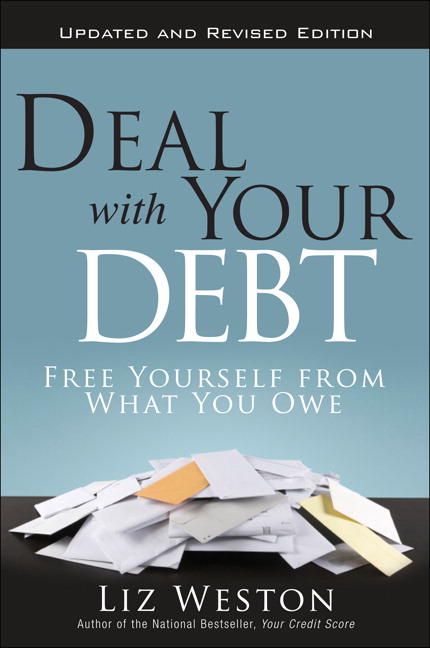
DWYD cover2013“Deal with Your Debt” is now available, and I’m giving away five copies this week.

To enter to win, leave a comment here on my blog (not my Facebook page).

Click on the tab above the post that says “comments.” Make sure to include your email address, which won’t show up with your comment, but I’ll be able to see it.

If you haven’t commented before, it may take a little while for your comment to show up since comments are moderated.

The winners will be chosen at random Friday night. Over the weekend, please check your email (including your spam filter). If I don’t hear from a winner by noon Pacific time on Monday, his or her prize will be forfeited and I’ll pick another winner.

Also, check back here often for other giveaways.

The deadline to enter is midnight Pacific time on Friday. So–comment away!

Filed Under: Liz's Blog Tagged With: Bankruptcy, book giveaway, books, Budgeting, collection agencies, collections, Credit Bureaus, Credit Cards, Credit Reports, Credit Scores, credit scoring, Deal with Your Debt, debt, debt collection, debt settlement, Debts, mortgages, Retirement, retirement savings, Student Loans

Combat zone contractors don’t get Roth IRA perk

March 4, 2013 By Liz Weston

Dear Liz: I’m working as a contractor in Afghanistan. Since we are overseas in a combat zone, our pay is nontaxable. Can I contribute some of this untaxed money to a Roth IRA and still be able to withdraw it tax free in retirement? I’ve heard that’s true, but the way I read the law it seems that the money has to come from “taxable” wages or something along those lines. I need clarification.

Answer: If you were serving in the military, rather than as a contractor, you would be able to contribute some of your untaxed combat-zone pay to a Roth IRA and have tax-free withdrawals in retirement. That’s a unique perk of the military, however.

Service members’ tax-free combat zone pay qualifies as income for purposes of making an IRA or Roth IRA contribution because of the 2006 Heroes Earned Retirement Opportunities Act, said Joseph Montanaro, a certified financial planner with USAA.

If your pay is tax free as a contractor, it’s probably because you qualify for the foreign earned income exclusion, which protects some or all of your pay from U.S. taxes (up to $95,100 for 2012), Montanaro said. Your eligibility for this exclusion has nothing to do with working in a combat zone. It has to do with your residence or physical presence abroad.

Income that is excluded this way cannot be used as compensation for the purpose of making an IRA contribution, Montanaro said. It would, however, have to be included when determining your eligibility to make a Roth contribution.

Filed Under: Q&A, Retirement Tagged With: Heroes Earned Retirement Opportunities Act, Individual Retirement Account, military, Retirement, retirement savings, Roth IRA

  • « Go to Previous Page
  • Page 1
  • Interim pages omitted …
  • Page 38
  • Page 39
  • Page 40
  • Page 41
  • Page 42
  • Page 43
  • Go to Next Page »

Primary Sidebar

Search

Copyright © 2026 · Ask Liz Weston 2.0 On Genesis Framework · WordPress · Log in