• Skip to main content
  • Skip to primary sidebar

Ask Liz Weston

Get smart with your money

  • About
  • Newsletter
  • Liz’s Books
  • Speaking
  • Disclosure
  • Contact

collections

Retiree burdened with unpayable student loan debt

August 26, 2013 By Liz Weston

Dear Liz: In a recent column, you fielded a query from parents whose son took out student loans in the mother’s name. You wrote, “If your only income is from Social Security and you don’t have any other property a creditor can legally take, you may be ‘judgment proof,'” which means “a creditor wouldn’t be able to collect on a judgment against you.”

I understand this advice was meant for the mom. But could it equally apply to the borrower who benefited from the loan?

In my case, I will be 70 next year and my only income is Social Security. I owe about $80,000 in private student loans and about $80,000 in federal student loans. I can’t afford to pay either loan. Is there hope for me to get out from under this burden by being judgment-proof? Right now, I can’t afford to see a bankruptcy attorney. It is a struggle just to pay the rent and put some food on my table.

Answer: You can’t afford not to see a bankruptcy attorney. Federal student loan collectors have enormous powers to collect, including taking a portion of your Social Security check.

The concept of being “judgment proof” applies to collections of private student loans. Collectors for those loans may be held at bay if you are, indeed, judgment proof. But you really want an experienced bankruptcy attorney to review your situation to make sure that’s the case. Fortunately, many bankruptcy attorneys offer free or discounted initial sessions. You can get referrals from the National Assn. of Consumer Bankruptcy Attorneys at http://www.nacba.org.

Filed Under: Bankruptcy, Q&A, Student Loans Tagged With: Bankruptcy, collections, federal student loans, private student loans, Student Loans

Thursday’s need-to-know money news

August 1, 2013 By Liz Weston

Detroit stationDebt collectors are spying on creditors through social media, what consumers can learn from Detroit, and is it time to become the boss?

Are Debt Collectors Stalking You Online?
That friend request you just accepted might not be someone interested in playing Candy Crush with you.

3 Personal Finance Lessons Learned From Detroit’s Bankruptcy

Control your debt before it takes control you.

6 Ways to Prepare for Unexpected Financial Events
Expecting the unexpected could be the thing that pulls you through.

5 Basic Money Errors Retirees Make
From giving away money to relatives, to not keeping a budget, these mistakes can tarnish your golden years.

Making the Jump to Self-Employment
Are you ready to become your own boss?

Filed Under: Liz's Blog Tagged With: collections, debt, debt collectors, disasters, emergency preparedness, emergency savings, Retirement, self-employment

Co-signing card leads to collectors’ calls

July 9, 2013 By Liz Weston

Dear Liz: I co-signed a credit card for someone and the person defaulted on payment. I started making payments but could not continue because I became unemployed. The debt started at $15,631.23 but has gone up to $17,088.08 because of interest and fees. I previously had to go to court because my bank account was frozen. I recently got a notice about this again. Should I file for bankruptcy or try contacting the attorneys who are seeking payment? I am working part-time and have a tight budget. I don’t have anything saved and am living from paycheck to paycheck.

Answer: You should have gone to a bankruptcy attorney the first time you got sued.

Many people try to ignore their debts or hope that collection agencies will be lenient. That’s not a good strategy at a time when collectors are increasingly willing to file lawsuits to get paid, said Gerri Detweiler, director of consumer education for Credit.com. Once collectors have a judgment against you, they can freeze your bank accounts or garnishee your paycheck.

If you don’t have anything saved and can’t come up with any money for payments, you have little leverage in dealing with a collection agency. Bankruptcy may be your only recourse to get these collection efforts to stop.

A bankruptcy attorney can let you know whether you are “judgment proof,” which basically means that you have and make too little for a creditor to collect on any judgments. If you are judgment proof, you may not need to file for bankruptcy, but you may have to deal with frozen accounts and regular trips to court when a collector oversteps.

You can get a referral from the National Assn. of Consumer Bankruptcy Attorneys at http://www.nacba.org.

The only silver lining of this situation is that you’ve provided other people with a clear lesson in why they shouldn’t co-sign a credit card or any other loan for someone else.

Filed Under: Bankruptcy, Credit & Debt, Credit Cards, Q&A Tagged With: Bankruptcy, collections, Credit Cards, debt collection, debt settlement, Debts

My book is out! Get it for free.

March 7, 2013 By Liz Weston

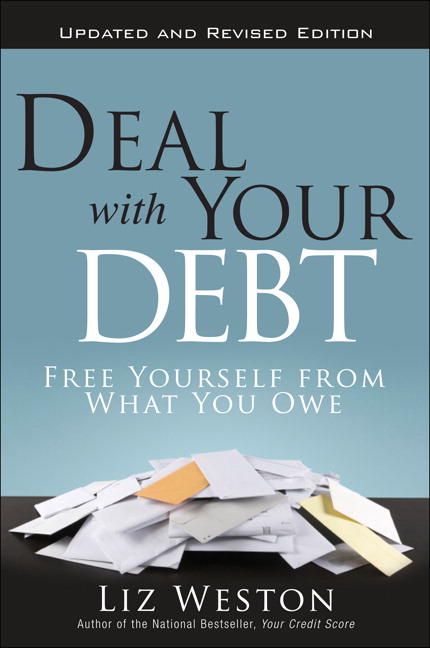
DWYD cover2013“Deal with Your Debt” is now available, and I’m giving away five copies this week.

To enter to win, leave a comment here on my blog (not my Facebook page).

Click on the tab above the post that says “comments.” Make sure to include your email address, which won’t show up with your comment, but I’ll be able to see it.

If you haven’t commented before, it may take a little while for your comment to show up since comments are moderated.

The winners will be chosen at random Friday night. Over the weekend, please check your email (including your spam filter). If I don’t hear from a winner by noon Pacific time on Monday, his or her prize will be forfeited and I’ll pick another winner.

Also, check back here often for other giveaways.

The deadline to enter is midnight Pacific time on Friday. So–comment away!

Filed Under: Liz's Blog Tagged With: Bankruptcy, book giveaway, books, Budgeting, collection agencies, collections, Credit Bureaus, Credit Cards, Credit Reports, Credit Scores, credit scoring, Deal with Your Debt, debt, debt collection, debt settlement, Debts, mortgages, Retirement, retirement savings, Student Loans

Be careful when settling old debts

January 28, 2013 By Liz Weston

Dear Liz: I paid all of my old collection accounts except for two, which now are beyond the statute of limitations. I would like to find the best way to negotiate with the collection agencies without getting sued. Even though the original delinquency was over four years ago, the agencies are reporting these every month as current debt, which is really hurting my credit score. My intent is to offer a lump-sum settlement amount if they will remove the report from my credit file with the bureaus, or alternately in return for a “paid” notation on my report file. However, I cannot afford to pay the amount they say I owe.

Answer: If the collection agencies are simply reporting your debts each month with a correct “date of last activity” — usually the date you stopped paying the original creditor — your credit scores aren’t being hurt anew each month. If the agencies are reporting a new date of last activity each month, however, they are illegally re-aging your debts. You can dispute this illegal reporting with the credit bureaus and directly with the collection agencies. If the errors aren’t corrected, you can file a complaint with the Consumer Financial Protection Bureau, which took over regulation of the major credit bureaus last year.

Filing disputes is not something you’d want to do if the debts are still within the statute of limitations, said Michael Bovee, president of Consumers Recovery Network, which specializes in debt settlement. You wouldn’t want to draw attention to yourself or your debts. But you run little risk in filing a dispute now since the debts are too old for the collectors to file a legitimate lawsuit.

  • Liz Weston
  • Recent columns
  • House GOP seeks steep cuts while raising debt ceiling House GOP seeks steep cuts while raising debt ceiling
  • Consumers and lenders may receive different credit scores Consumers and lenders may receive different credit scores
  •  The ABCs of college financial aid The ABCs of college financial aid

Bovee said that simply contacting the agencies about the debts shouldn’t restart the statute of limitations, but debt expert Gerri Detweiler of Credit.com advised caution.

“It may be well worth it to consult a consumer law attorney,” Detweiler said. “Otherwise [you] may reset the clock on these debts and owe the entire amount plus interest.”

You can get referrals to consumer law attorneys at the National Assn. of Consumer Advocates, http://www.naca.net.

You don’t have to pay the reported debts in full to reach a settlement, Bovee and Detweiler agreed. Often the totals reported are inflated by interest and fees, and the collection agencies probably paid only pennies on the dollar to buy this debt.

Start by saying you have only so much money to work with and offer 20% to 30% of what the agency says you owe.

“A realistic expectation for negotiating a debt this old would be to settle the account for 50% or less than the current balance owed,” Bovee said. “If they raise objections, there is no problem in mentioning that you are aware that the debt is past the statute of limitations for you to be sued, but that you are just trying to do the right thing.”

Don’t say you’re trying to improve your credit, since that gives the collector leverage over you, Bovee said.

You can negotiate to have the collections deleted from your credit reports, but the original delinquencies and charge-offs will remain and will continue to affect your credit scores until they pass the seven-year mark.

Filed Under: Credit & Debt, Q&A Tagged With: collection agencies, collections, debt collection, debt settlement, debtcollection, Debts, Fair Debt Collection Practices Act, statute of limitations

Government recoups defaulted student loan debt

November 26, 2012 By Liz Weston

Dear Liz: I read your response to the person questioning the rationale behind taxpayer-supported federal student loans. Your response was well written, but do you have any information about how much money is owed to the government for student loans and what percentage of all the loans are actually paid back in full? You mentioned that the government can garnish wages and Social Security checks and seize tax refunds, but does the government follow through and hold these people accountable? Does the government have personnel to do this or is this just a threat?

Answer: Millions of unhappy student loan borrowers can assure you the government’s considerable powers to collect defaulted student loans are much more than a threat. In addition to its own collection activities, the U.S. Department of Education also hires a number of private collection agencies to help recoup what’s owed.

As a result, the government collects more than 100 cents on every defaulted dollar once accumulated interest and penalties are included, according to the Education Department’s most recent report. On a net present value basis — when future collections are discounted back to today’s dollars — the government recovers about 80% of the defaulted debt.

Decades ago, it was possible to skip out on federal student loan debt without serious consequences. Public outrage over that fact led to much stronger collection efforts. That has resulted in the federal government recovering about $10 billion in defaulted student loan debt every year, said Mark Kantrowitz, publisher of the FinAid.org and FastWeb financial aid sites.

Filed Under: College, College Savings, Credit & Debt, Q&A, Student Loans Tagged With: collection agencies, collections, debt collection, federal student loans, Student Loan, student loan debt, Student Loans

  • « Go to Previous Page
  • Page 1
  • Page 2
  • Page 3
  • Page 4
  • Go to Next Page »

Primary Sidebar

Search

Copyright © 2026 · Ask Liz Weston 2.0 On Genesis Framework · WordPress · Log in